Molekula
Kaliumhydroxid-Pellets – Ph. Eur., BP, USP, NF, FCC
Potassium hydroxide pellets - Ph. Eur, BP, USP, NF, FCC
Belieferung von über 4.500 Kunden in mehr als 80 Ländern
ISO 9001:2015 & ISO 14001:2015 zertifiziert · Lieferant für Laboratorien und Industrie seit 2000 · Die aufgelisteten Packungsgrößen sind ein Ausgangspunkt — wir fertigen, beziehen und konfektionieren nach Ihren Bedarfsmengen.
Kaliumhydroxid-Plätzchen sind eine stark alkalische Verbindung, die in der chemischen Synthese, der Lebensmittelverarbeitung, der pH-Regulierung und der Seifenherstellung weit verbreitet ist. Sie dienen außerdem als Elektrolyt in Alkalibatterien, als Badbestandteil in der Galvanotechnik, als Nassätzmittel in der Halbleiterfertigung und als Reagenz für alkalimetrische Titrationen. Diese hochreine Qualität erfüllt die Normen Ph. Eur, BP, USP, NF und FCC und gewährleistet so die Eignung für pharmazeutische und kosmetische Anwendungen sowie für Anwendungen in Lebensmittelqualität. Mit der CAS-Nummer 1310-58-3, der Summenformel KOH und einem Molekulargewicht von 56.11 wird das Produkt bei Umgebungstemperatur gelagert. Aufgrund seiner Gefährlichkeit, die durch das Signalwort „Gefahr“ gekennzeichnet ist, ist eine sachgemäße Handhabung erforderlich. Molekula liefert Kaliumhydroxid-Plätzchen von Forschungs- bis zu Großmengen mit vollständiger Dokumentation und Rückverfolgbarkeit nach ISO 9001:2015.
Abbildung dient nur zur Veranschaulichung. Weitere Verpackungen und Gebindegrößen sind erhältlich.
Preise und Verpackungsgrößen
Verpackungsgrößen und Preise
Preis auf Anfrage — Verpackungen von Forschungs- bis Großmengen erhältlich.
Benötigen Sie eine andere Menge oder Verpackung?
Teilen Sie uns mit, welche Mengen Sie benötigen und wann — ob Fässer, IBCs, Säcke oder eine einmalige Großlieferung. Wir produzieren oder beschaffen das Produkt und unterbreiten Ihnen ein Angebot.
Preise verstehen sich zzgl. MwSt./Umsatzsteuer und ohne Versandkosten.
Spezifikationen
| Property | Value |
|---|---|
| Identification | Conforms to reference |
| Chloride (Cl-) | ≤0.008% |
| Assay | 85.0 - 100.5% |
| Residual Solvents | Excluded by the manufacturing process |
| Heavy Metals (Pb) | ≤0.0005% |
| Iron (Fe) | ≤0.0010% |
| Lead (Pb) | ≤0.0002% |
| Mercury (Hg) | ≤0.00001% |
| Arsenic (As) | ≤0.0003% |
| Calcium (Ca) | ≤0.002% |
| Copper (Cu) | ≤0.0005% |
| Zinc (Zn) | ≤0.0025% |
| Sodium (Na) | ≤1.0% |
| Aluminium (Al) | ≤0.001% |
| Sulphates (SO4)(2-) | ≤0.005% |
| Phosphate (PO4)3- | ≤0.002% |
| Assay (acidimetric) | ≥85.0% |
| Total nitrogen (N) | ≤0.0005% |
| Silicon Dioxide (SiO2) | ≤0.01% |
| Assay (K) | ≥59.9% |
| Potassium carbonate (K₂CO₃) | ≤2.0% |
Lagerung und Handhabung
| Property | Value |
|---|---|
| Lagertemperatur | Ambient |
| Transportklasse | 8 |
| Verpackungsgruppe | II |
| Säuregehalt | Base |
Literaturwerte
Veröffentlichte physikalische Eigenschaften der Substanz, keine Chargenspezifikationen.
| Property | Value |
|---|---|
| Erscheinungsbild | White rhombic crystals |
| Geruch | Odorless |
| Schmelzpunkt | 380 °C |
| Siedepunkt | 1327 °C |
| Dichte | 2.044 g/cm³ |
| Löslichkeit (andere Lösungsmittel) | Soluble in ethanol, methanol |
| Dampfdruck | 1 mmHg at 714 °C |
PubChem CID 14797 (HSDB, ICSC)
Identifizierung
| Property | Value |
|---|---|
| SKU | 90037453 |
| CAS-Nummer | 1310-58-3 |
| IUPAC-Name | potassium hydroxide |
| EG-Nummer | 215-181-3 |
| Molekülformel | KOH |
| Molekulargewicht | 56.11 |
| Exakte Masse | 55.9664 |
| SMILES | [OH-].[K+] |
| InChIKey | KWYUFKZDYYNOTN-UHFFFAOYSA-M |
| InChI | InChI=1S/K.H2O/h;1H2/q+1;/p-1 |
| PubChem CID | 14797 |
| UN-Nummer | UN1813 |
| REACH-Code | Y110 |
| TSCA aufgeführt | Ja |
| HTS-Code | 2815.20.0050 |
| Zolltarifnummer | 2815200000 |
Sicherheit & GHS
-
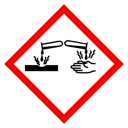 Corrosive
GHS05
Corrosive
GHS05
-
 Health Hazard
GHS07
Health Hazard
GHS07
Gefahrenhinweise
- H290 Kann gegenüber Metallen korrosiv sein.
- H302 Gesundheitsschädlich bei Verschlucken.
- H314 (sub cat. 1A) Verursacht schwere Verätzungen der Haut und schwere Augenschäden.
Vorsichtsmaßnahmen
- P260 Staub / Rauch / Gas / Nebel / Dampf / Aerosol nicht einatmen.
- P280 Schutzhandschuhe / Schutzkleidung / Augenschutz / Gesichtsschutz tragen.
- P301+312 Bei Verschlucken: Bei Unwohlsein Giftinformationszentrum / Arzt / … anrufen.
- P301+330 BEI EINSCHLUCKEN: Mund ausspülen. **ERBRECHEN NICHT HERBEIFÜHREN**.
- P303+361 Bei Berührung mit der Haut (oder Haaren): Sofort alle kontaminierten Kleidungsstücke abnehmen. Mit Wasser abspülen oder duschen.
- P305+351+338 Bei Kontakt mit den Augen: Einige Minuten lang behutsam mit Wasser spülen. Eventuell vorhandene Kontaktlinsen nach Möglichkeit entfernen. Weiter spülen.
Dokumente
Sicherheitsdatenblätter (SDS)
Verfügbar in English, French, German, Italian, Portuguese, Spanish.
Zertifikat der Analyse (CoA) nach Charge
Geben Sie eine Chargen- oder Seriennummer ein, um die CoA für diese spezifische Charge abzurufen. Wir können eine erstellen, wenn keine PDF-Datei vorliegt, basierend auf den Spezifikationsdaten.
Synonyme
Es wurden keine alternativen Namen für dieses Produkt aufgezeichnet.
Häufig gestellte Fragen
Was sind die wichtigsten industriellen und lebensmitteltechnischen Anwendungen für Potassium hydroxide Pellets?
Potassium hydroxide Pellets werden in der Lebensmittelverarbeitung (z. B. pH-Regulierung in Erfrischungsgetränken, Tiernahrung), in der chemischen Herstellung (z. B. Biodieselproduktion, Seifen, Waschmittel) und in der Pharmazie (z. B. als alkalisches Reagenz bei APIs) eingesetzt.
Wie lauten die Summenformel und die Molmasse von Potassium hydroxide Pellets?
Die Summenformel lautet **KOH**, die Molmasse beträgt **56.11 g/mol**.
Welche Sicherheitseinstufung haben Potassium hydroxide Pellets und wie sollten sie gehandhabt werden?
Potassium hydroxide Pellets sind als **Gefahr** eingestuft (ätzend, verursacht schwere Haut- und Augenschäden). Mit Handschuhen und Schutzbrille in einem gut belüfteten Bereich handhaben und Kontakt mit Feuchtigkeit vermeiden.
Welche Qualitäten von Potassium hydroxide Pellets liefert Molekula und sind sie für pharmazeutische/lebensmitteltechnische Anwendungen geeignet?
Molekula liefert **Ph. Eur-, BP-, USP-, NF- und FCC-Qualitäten**, die alle den pharmazeutischen und lebensmitteltechnischen Standards für regulierte Anwendungen entsprechen.
Kann Molekula Potassium hydroxide Pellets in großen Mengen liefern und welche Verpackungsoptionen gibt es?
Ja, Großmengen sind verfügbar – typischerweise in **25 kg Säcken, 500 kg Fässern oder IBCs (1000 kg)** – individuelle Verpackungsoptionen auf Anfrage.
Welche Dokumentation wird mit einer Bestellung von Potassium hydroxide Pellets bereitgestellt, insbesondere für pharmazeutische/lebensmitteltaugliche Chargen?
Jede Bestellung enthält ein **Analysenzertifikat (CoA), ein Sicherheitsdatenblatt (SDS) und chargenspezifische Dokumentation** (z. B. Ph. Eur/USP-Konformitätszertifikate) zur Rückverfolgbarkeit und Einhaltung gesetzlicher Vorschriften.
Bereit zum Bestellen oder benötigen Sie ein Sonderpack?
Teilen Sie uns das Produkt, die Reinheitsstufe und die Menge mit — Molekula antwortet in der Regel innerhalb eines Werktages mit Preis und Lieferzeit.